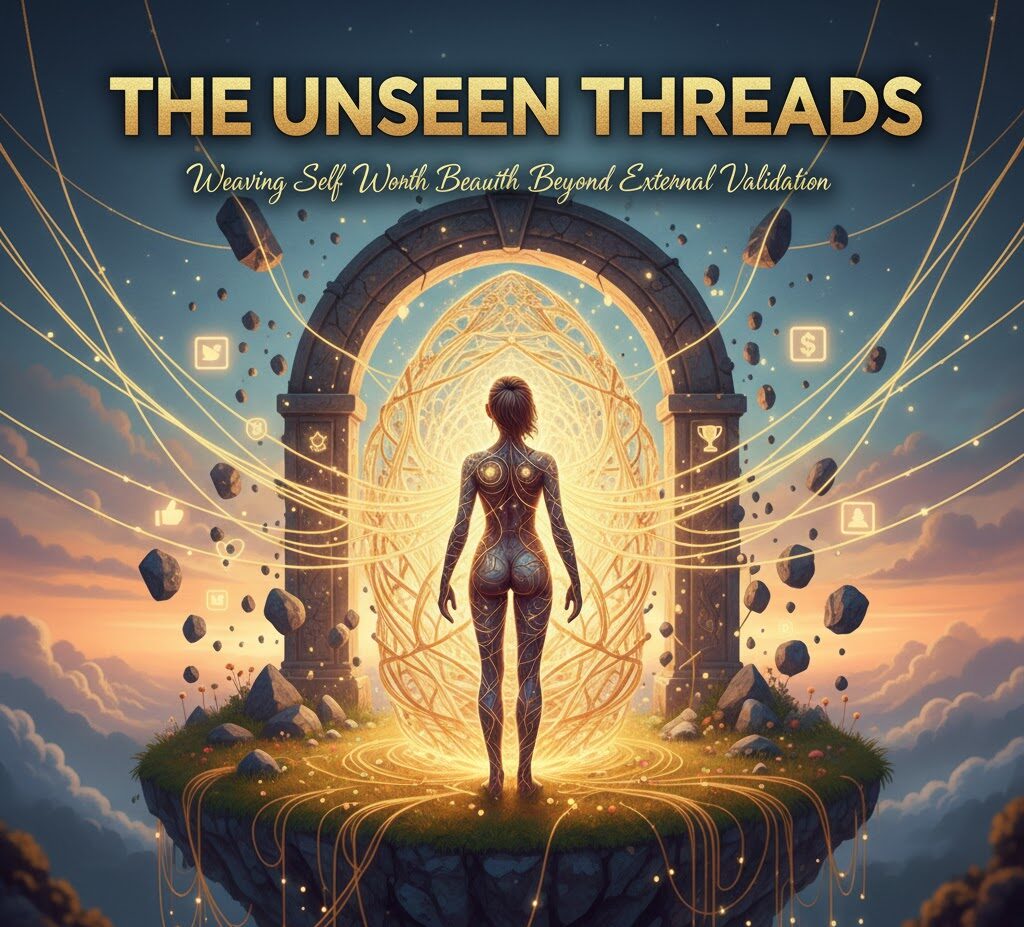
There’s a quiet hum I’ve noticed lately. It’s not a loud, dramatic thing – more like the subtle vibration of a tuning fork, resonating deep within. It’s the sound of becoming, I think. Of a slow, steady shedding of old skins and the quiet emergence of something truer. Maybe you hear it too? Maybe you’re feeling that gentle unease, that feeling of being both restless and strangely at peace, all at once.
 This whole “self-growth” thing… It’s not always pretty, is it? It’s not a highlight reel. It’s a series of messy experiments, clumsy steps forward, and the occasional faceplant. It’s that feeling of wanting to change, to evolve, but also being terrified of letting go of the familiar, even when the familiar is a little… suffocating.
I get it. I’ve been there. For years, I chased the external markers of success – the promotions, the accolades, the perfect relationships. And for years, there was this persistent emptiness, this feeling that something was fundamentally off. I was like a ship constantly tacking, buffeted by every wind of external approval. I realized I was living someone else’s definition of “success.” I was lost in a sea of “shoulds.”
Why Growth Feels So Damn Slow
One of the biggest myths about self-growth is that it’s a linear process. That there’s a clear path from Point A to a shiny Point B, and all you have to do is follow the steps. But life, and growth, rarely works that way, does it? It’s more like a spiral, revisiting the same lessons in new forms, at different depths. You think you’ve “gotten over” something, and bam! It shows up again, wearing a slightly different mask. This is normal. This is life.
It’s not that you’re failing. It’s that the universe is offering you another opportunity to integrate the lesson more fully. The first time you encounter a challenge, it’s about awareness. The second time, it’s about integration. The third, mastery. Each cycle gives you another chance to learn, to grow, and to become more resilient. Every stumble, every setback, becomes a teacher.
Another reason growth feels slow is because it’s often invisible. The big transformations – the ones that change the trajectory of your life – often happen in the quiet spaces, in the moments when you think you’re doing “nothing.” It’s in the hours spent journaling, meditating, or simply sitting with your thoughts. It’s in the space between the thoughts, where a deeper knowing arises. This is where growth usually feels invisible, like the roots of a tree, quietly spreading and strengthening beneath the surface.
There’s also the simple fact that real growth takes time. You can’t fast-track the evolution of your inner world. You can’t download a new personality. It’s a process of unearthing, of peeling back layers, of becoming more authentically you. And that, my friend, is a journey, not a destination. Think of it like this: You wouldn’t expect a seed to become a full-grown tree overnight. So why would you expect instant results from your own inner work?
The Internal Shifts That Actually Matter
So, if it’s not about the quick fixes, the overnight transformations, what *is* it about? What are the internal shifts that actually move the needle? Here are a few that have made a world of difference in my own life, and in the lives of the many people I’ve had the privilege of guiding:
- Self-Awareness: This is the bedrock. It’s the ability to observe your thoughts, feelings, and behaviors without judgment. It’s the skill of noticing when you’re triggered, when you’re acting out of fear, or when you’re simply running on autopilot. It is noticing the *why* of your reactions, not just the *what*. Start by simply noticing. Journaling can be a great tool for this.
- Emotional Regulation: This isn’t about suppressing your emotions. It’s about learning to feel them fully, without being overwhelmed by them. It’s about developing the capacity to ride the waves of your emotions without being swept away by them. Mindfulness practices, deep breathing, and somatic work can be incredibly helpful here.
- Authenticity: This is about shedding the masks, the personas, and the “shoulds” that you’ve accumulated over the years. It’s about being true to yourself, even when it’s uncomfortable. It’s about living in alignment with your values, even when it means going against the grain.
- Resilience: Life is going to throw curveballs. It’s inevitable. Resilience is your capacity to bounce back from adversity, to learn from your mistakes, and to keep moving forward, even when the path gets dark. It’s not about avoiding pain, but about learning to navigate it with grace and strength.
- Self-Compassion: Treat yourself the way you would treat a dear friend. This is about kindness, understanding, and forgiveness, especially when you make mistakes. It’s about recognizing that you are human, and that you are worthy of love and acceptance, flaws and all.
Common Pitfalls on the Path
We’re all human, and as such, we stumble. There are some common traps that make this journey of self-growth much harder than it needs to be. Avoiding these will save you a lot of heartache:
- Chasing External Validation: This is like trying to fill a bottomless pit. No amount of praise, recognition, or approval from others will ever truly satisfy you. The source of your value needs to come from within.
- Perfectionism: The idea that you have to be perfect, that you have to get it right all the time, is crippling. Perfectionism is just a form of self-criticism in disguise. Embrace the imperfections. They’re part of what makes you, you.
- Overthinking: Your mind can be a powerful tool, but it can also be a relentless critic. Don’t get trapped in endless loops of thought. Learn to quiet the mental chatter and trust your intuition.
- Comparison: Comparing yourself to others is a thief of joy. Everyone is on their own unique journey, with their own set of challenges and triumphs. Focus on your own path.
- Ignoring Your Body: This is a big one. Our bodies are incredibly wise. They hold the key to so much wisdom. Ignoring the signals your body is sending – the fatigue, the tension, the pain – is like trying to drive a car with a flat tire.
Busting the Myths: Real Talk About Self-Growth
There are a lot of myths out there about self-growth, and they can be incredibly misleading. Here are a few of the most common ones:
- Myth: You can change overnight.Reality: Transformation is a process, not an event. It takes time, patience, and persistence.
- Myth: Motivation is the key.Reality: Motivation is fleeting. Discipline, consistency, and a deep sense of purpose are far more reliable.
- Myth: You need to be “positive” all the time.Reality: It’s okay to feel sad, angry, or frustrated. Trying to suppress your emotions will only backfire. Allow yourself to feel what you feel.
- Myth: You have to do it alone.Reality: You don’t have to go it alone. Seek support from friends, family, therapists, coaches, or support groups. Sharing the journey makes it lighter.
- Myth: Once you reach a certain level of “growth,” you’re done.Reality: Growth is a lifelong journey. There is no finish line. The more you grow, the more you realize how much more there is to learn.
The Long-Term Impact: Beyond the Surface
What’s the point of all this? Why put in the work? Because the benefits of self-growth extend far beyond the surface level. It’s not just about feeling “good.” It’s about creating a life that is aligned with your values, a life filled with meaning and purpose. It’s about cultivating a deep sense of inner peace and freedom.
In the long run, investing in self-growth leads to:
- Increased Peace of Mind: The more you understand yourself, the less likely you are to be thrown off balance by the ups and downs of life. You develop a sense of inner stability, a knowing that you can handle whatever comes your way.
- Greater Self-Confidence: As you become more authentic, as you learn to trust your intuition, your confidence will naturally soar. You will feel more comfortable in your own skin.
- Better Decision-Making: When you know your values, your priorities, and what truly matters to you, making decisions becomes much easier. You’ll be less swayed by external pressures and more guided by your inner compass.
- More Meaningful Relationships: As you grow, you’ll attract people who resonate with your authenticity. Your relationships will deepen, and you’ll experience greater connection and intimacy.
- Enhanced Resilience: When you learn to navigate challenges with grace and strength, you become incredibly resilient. You’ll be able to bounce back from setbacks with greater ease.
The impact is profound. It touches every aspect of your life.
Modern Relevance: Navigating the Emotional Landscape of 2026
The world is changing, and so are we. The emotional and social environment of 2026 presents unique challenges. We are bombarded with information, with opinions, with pressures to conform. Social media is both a blessing and a curse. The pace of life is faster than ever. How do we navigate this landscape and still find our center? This is the million-dollar question.
The key, I believe, lies in cultivating the skills of self-awareness, emotional regulation, and resilience. It’s about learning to discern between the noise and the signal, between what truly matters and what doesn’t. It’s about developing the capacity to stay grounded in the face of constant change.
It’s also about building community. Finding your tribe. Surrounding yourself with people who support your growth, who challenge you in positive ways, and who celebrate your victories. In this age of hyper-connectivity, it’s easy to feel isolated. Seek connection. Invest in your relationships.
Future Outlook: Maturity, Awareness, and Adaptability
Looking ahead, the qualities of maturity, awareness, and adaptability will be more important than ever. The ability to learn, unlearn, and relearn will be essential. The capacity to embrace change, to navigate uncertainty, and to thrive in a complex and ever-evolving world will define our well-being.
Maturity is not just about getting older. It’s about cultivating wisdom, compassion, and a deeper understanding of yourself and the world around you. Awareness is about developing a heightened sense of presence, a capacity to be fully engaged in the here and now. Adaptability is about embracing change as an opportunity for growth, rather than a threat.
The future of self-growth lies in the integration of these qualities. It lies in the commitment to continuous learning, to lifelong exploration, and to the unwavering pursuit of a more authentic and fulfilling life. It’s about cultivating the stillness within, the peace that resides at the core of your being, and learning to draw upon that strength whenever you need it.
This is a journey. Not a race. And I’m right here beside you on it, friend.
FAQ: Your Burning Questions About Self-Growth Answered
Here are some of the questions I often hear when people start their journey:
- Where do I even start with self-growth?Start with awareness. Start by noticing your thoughts, feelings, and behaviors. Journaling, meditation, and spending time in nature are great starting points.
- How do I deal with negative self-talk?Become aware of it. Treat yourself with kindness and compassion. Challenge the negative thoughts, and replace them with more supportive ones.
- How do I stay motivated to keep growing?Focus on your “why.” Connect with your values and your purpose. Build habits, and celebrate your progress.
- What if I feel like I’m not making progress?Trust the process. Remember that growth is not linear. Be patient with yourself, and celebrate the small victories.
- How do I know if I’m “doing it right?”There is no “right.” There is only your path. If you are being honest with yourself and striving to grow, you are doing it right.
- Is it possible to change my personality?You can’t completely change your personality, but you can change your behaviors, your habits, and your mindset. And that can make a world of difference.
- How do I deal with setbacks?Acknowledge them, learn from them, and keep moving forward. Don’t let setbacks define you. Let them refine you.
- Should I seek professional help?Absolutely. A therapist, coach, or mentor can provide valuable support and guidance. There is no shame in seeking help. It’s a sign of strength.
Remember, self-growth is a journey, not a destination. Embrace the process, be kind to yourself, and celebrate every step along the way. You’ve got this.
If you’re interested in taking a deeper dive, you can explore more resources at Jamgro, where you’ll find additional tools and insights to guide you on your path. Also, you may find the following article related to your journey: The Unfolding Self: Navigating the Unexpected Turns of Personal Evolution.