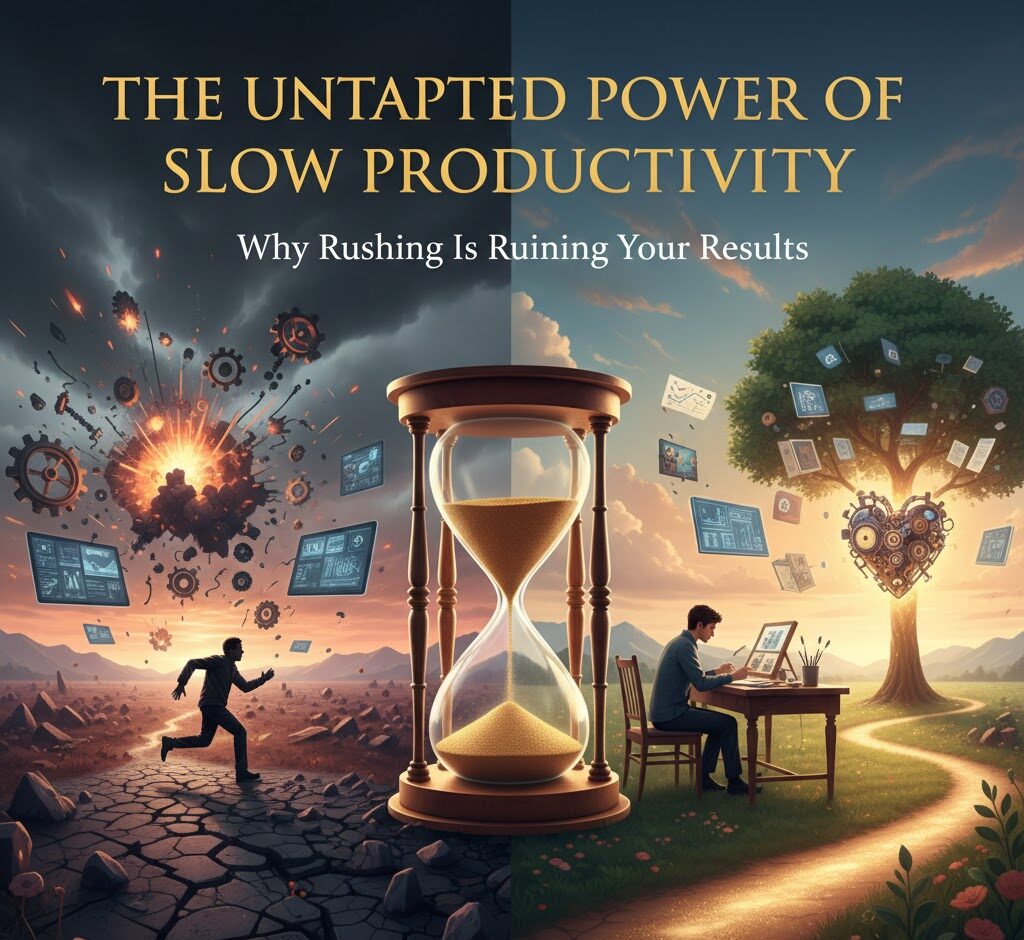
Remember that feeling? You’re staring at your screen, words blurring, your mind a runaway train. You’ve been “working” for hours, but what have you *actually* accomplished? The truth is, most of us have been there. We’re juggling endless tasks, bombarded with notifications, and trying to keep up in a world that never sleeps. This is where productivity silently collapses.
 We’re told to “hustle,” to work harder, to do more. But what if the real problem isn’t a lack of effort, but a lack of focus? What if the key to unlocking your true potential lies not in doing more, but in *concentrating* better?
The Productivity Breakdown: Why Focus Fails
Let’s be real. Modern life is a focus-killer. It’s a never-ending buffet of distractions, designed to pull you away from what matters. Here’s what’s sabotaging your ability to concentrate:
- Information Overload: Our brains are constantly bombarded with news, social media updates, and emails. It’s tough to filter out the noise and zero in on a single task.
- Multitasking Myth: Despite what we’re told, multitasking is a lie. Your brain can’t truly focus on multiple things at once. Instead, it switches rapidly between tasks, leading to reduced efficiency and increased errors.
- The Phone Addiction Trap: That little device in your pocket is a master manipulator. Each notification, each buzz, is a siren song, pulling you away from your work.
- Poor Planning: Without a clear plan, your brain doesn’t know what to prioritize. This leads to aimless work and a feeling of being overwhelmed.
- Lack of Energy Management: We often neglect our physical and mental energy. This results in crashes, burnout, and an inability to concentrate.
Most people stay busy but avoid this. They mistake activity for achievement. The truth? Real productivity starts when you learn to protect your focus.
The Focus Fix: Practical Systems, Not Hacks
Forget the quick fixes and empty motivational quotes. Building real focus takes a strategic approach. Here are some tested systems you can use to regain control of your attention:
1. Master the Pomodoro Technique
This is a time management method. It’s deceptively simple, yet incredibly effective. Here’s how it works:
- Choose a task.
- Set a timer for 25 minutes (the “pomodoro”).
- Focus on the task until the timer rings.
- Take a 5-minute break.
- After every four “pomodoros,” take a longer break (20-30 minutes).
The Pomodoro Technique helps you concentrate and gives your brain the breaks it needs. It forces you to focus in short bursts, which is more manageable than trying to concentrate for hours on end. You’ll find it can boost your focus, reduce mental fatigue, and make tasks feel less daunting.
2. Time Blocking for Focused Work
Time blocking is where you schedule specific blocks of time for certain activities. This helps to minimize distractions and lets you plan your day more proactively. Start by:
- Listing all your tasks.
- Estimating how long each task will take.
- Blocking off time in your calendar for each task.
Time blocking allows you to structure your day. This structure can help you make the most of your time by having your day planned out ahead of time, which limits distractions. It will help you tackle high-impact work.
3. Prioritize Ruthlessly
Not all tasks are created equal. You need to identify the most important ones. This is about making sure you are spending your time on high-impact work. Consider:
- The Eisenhower Matrix: Categorize tasks based on urgency and importance. Focus on the urgent/important tasks first, then the important but not urgent ones.
- The 80/20 Rule (Pareto Principle): Identify the 20% of your tasks that yield 80% of your results.
Focus on what matters the most and delegate or eliminate the rest.
4. Minimize Distractions, Maximize Focus
Your environment significantly impacts your ability to concentrate. Here are some practical tips:
- Create a Dedicated Workspace: If possible, designate a specific area for work. This helps your brain associate that space with focus.
- Silence Notifications: Turn off all non-essential notifications on your phone and computer.
- Use Website Blockers: Install tools that block distracting websites during work hours.
- Use Noise-Canceling Headphones: They can help you block out distracting sounds.
You can improve your focus by decreasing distractions.
5. Fuel Your Brain (and Body)
Your physical and mental health are directly linked to your ability to concentrate. Focus on:
- Sleep: Aim for 7-8 hours of quality sleep per night.
- Exercise: Regular physical activity boosts brain function and reduces stress.
- Nutrition: Eat a brain-healthy diet rich in fruits, vegetables, and healthy fats.
- Hydration: Stay hydrated throughout the day.
These habits can improve your concentration and overall well-being.
6. Practice Mindfulness
Mindfulness is the practice of focusing on the present moment. It’s a powerful tool for improving focus and managing distractions. Here’s how to get started:
- Meditation: Even a few minutes of daily meditation can help train your brain to focus.
- Deep Breathing: Take a few deep breaths whenever you feel your mind wandering.
- Mindful Breaks: During your breaks, pay attention to your senses and the present moment.
Common Productivity Mistakes (and How to Avoid Them)
Most people repeat the same productivity mistakes, sabotaging their efforts. Here are some of the most common:
- Multitasking: Trying to do too many things at once. Stop it.
- Perfectionism: Setting unrealistic standards that lead to procrastination. Aim for “good enough” instead.
- Lack of Breaks: Overworking without breaks leads to burnout and reduced focus. Implement the Pomodoro Technique.
- Poor Planning: Not having a clear plan for your day. Use time blocking and to-do lists.
- Ignoring Energy Levels: Pushing through fatigue, rather than resting and recharging. Prioritize sleep and exercise.
- Focusing on “Busywork”: Confusing activity with accomplishment. Prioritize ruthlessly.
The Long-Term Impact: Why Focus Matters
The ability to focus isn’t just about getting more done. It has a profound impact on your:
- Performance: Improved concentration leads to better work quality, faster execution, and greater efficiency.
- Income: Increased productivity translates into more value creation and earning potential.
- Mental Health: Reduced stress, improved focus, and a sense of accomplishment boost well-being and happiness.
By mastering your focus, you’re not just working smarter; you’re creating a more fulfilling and successful life.
The Future of Focus: Habits for 2026 and Beyond
The digital landscape is constantly evolving. To thrive in 2026 and beyond, you’ll need to adapt and embrace new habits:
- Embrace “Deep Work”: Schedule dedicated time for focused, uninterrupted work, minimizing distractions.
- Prioritize Digital Detox: Regularly disconnect from your devices to give your brain a break.
- Invest in Mindfulness Tools: Explore apps and techniques that support mindfulness and focus.
- Seek Personalized Productivity Systems: Experiment to find the techniques that work best for your individual needs and preferences.
This is where productivity silently collapses…but it’s also where real change begins. By implementing the systems above and adapting to the ever-changing digital world, you can cultivate a focus that drives success and protects your well-being.
FAQ: Your Focus Questions Answered
Here are some of the most common questions about focus, answered with practical advice:
- How can I improve my focus at work? Prioritize tasks, use time-blocking, and minimize distractions. Also, try the Pomodoro Technique.
- What are the best techniques for time management? The Pomodoro Technique, time blocking, and the Eisenhower Matrix are all effective.
- How do I stop procrastinating? Break down tasks, set deadlines, and reward yourself for completing them.
- What can I do to improve my attention span? Practice mindfulness, get regular exercise, and create a structured routine.
- How do I deal with distractions? Minimize digital interruptions, create a dedicated workspace, and use noise-canceling headphones.
- Is multitasking good or bad? Multitasking is generally ineffective. Focus on one task at a time for better results.
- How important is sleep for productivity? Extremely important. Sleep is critical for focus, energy, and overall performance.
- What are some good productivity apps? There are many productivity apps available. Experiment with various apps to determine which ones are a good fit for you. Some options include time-blocking apps, to-do list apps, and focus-enhancing apps.
Improve focus today and visit Jamgro to learn more about how to live a productive and fulfilling life.