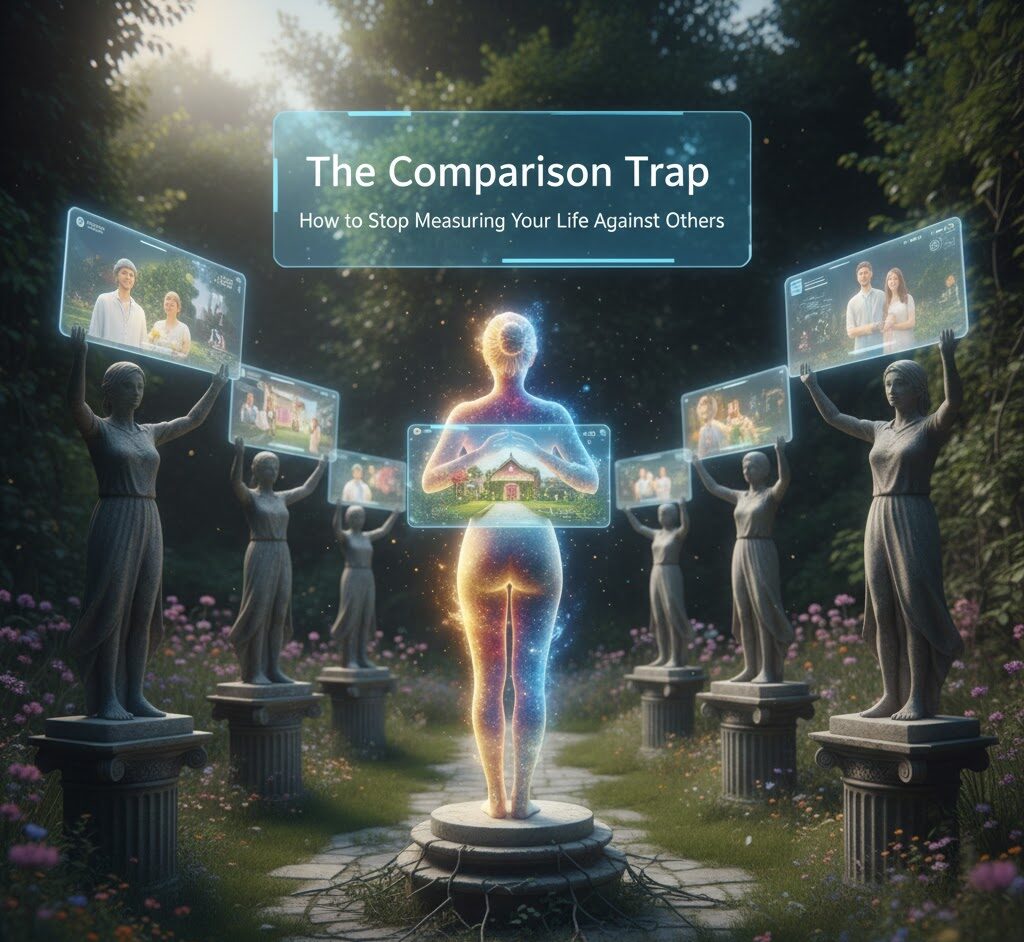
I still remember the sting. It wasn’t a physical pain, but a deep ache that settled in my chest, a feeling of inadequacy. I was scrolling through my feed – as we all do, right? – and came across a friend’s post. They’d just landed a dream job, a position I’d secretly coveted. My first reaction? A small, almost imperceptible knot of envy. Followed by a wave of that familiar feeling: I’m not good enough. We’ve all been there. It’s the invisible hand of comparison, constantly measuring our lives against others. This insidious habit quietly steals our joy, fuels self-doubt, and prevents us from fully embracing our own journeys. It’s a particularly potent issue in our modern world, where curated online realities and relentless exposure to others’ successes can create a distorted view of what’s truly possible and what “enough” looks like.
The Roots of the “Better Than” Trap
Where does this constant comparison originate? It’s not some inherent flaw, but a learned behavior rooted in our need for validation and our ingrained survival instincts. Think about it: our brains are wired to assess, to categorize, to compare. It’s a mechanism that helped our ancestors survive. Seeing a faster runner or a more skilled hunter meant recognizing a potential threat, or a better way of doing things. In today’s context, however, this survival mechanism often backfires.
One primary source of comparison is social conditioning. From a young age, we are bombarded with messages about what constitutes success: good grades, the “right” friends, the perfect body. Schools, families, and media subtly (and sometimes not so subtly) push us to conform to certain standards. These standards are often unrealistic and, crucially, often not aligned with our own authentic selves. This leads to a constant feeling of “not measuring up.” We start internalizing these external metrics, judging ourselves by standards that may not even be our own.
Then there’s the role of ego. Our ego, that part of us that craves recognition and validation, loves to compare. It thrives on a sense of superiority, even if it’s fleeting. Comparison provides a quick ego boost. We see someone “below” us and feel momentarily better, or we see someone “above” us and feel the sting of inadequacy. In either case, the ego is fed, but at the cost of our inner peace.
The rise of social media has turbocharged this comparison game. We’re no longer just comparing ourselves to our neighbors or classmates; we’re comparing ourselves to carefully constructed online personas, highlight reels of other people’s lives. These profiles often showcase the best moments, the carefully chosen angles, and the filtered realities. We’re left feeling like we’re always missing out or falling short, while others effortlessly achieve what we only dream of. The truth is, behind every perfect Instagram post, there is a real person battling their own set of challenges.
How Comparison Quietly Steals Your Life
The effects of comparison run much deeper than a fleeting feeling of envy. It’s a silent thief, eroding our sense of self-worth and hindering our progress in significant ways.
First and foremost, comparison breeds self-doubt. When we constantly measure ourselves against others, we inevitably find flaws. We start focusing on what we lack instead of appreciating what we have. This constant self-critique leads to a shrinking of our self-belief. We hesitate to take risks, fear failure, and sabotage our own efforts because we don’t believe we’re “good enough.” This is the mind quietly sabotaging progress.
Comparison also fuels procrastination. If we’re constantly feeling inadequate, we’re less likely to take action. Why bother starting a project, applying for a job, or pursuing a dream if we already feel like we’ll fail? This paralyzing effect keeps us stuck in our comfort zones, preventing us from realizing our full potential. Most people don’t notice this thought pattern at first.
Another major consequence is a skewed perception of reality. Comparison distorts our sense of perspective. We begin to believe that everyone else’s lives are perfect, their successes effortless. This leaves us feeling isolated, alone in our struggles. We forget that everyone is fighting their own battles, facing their own setbacks, and experiencing their own moments of self-doubt. The real shift begins when you see these patterns and the damage they do.
Comparison can also lead to a deep-seated feeling of dissatisfaction. No matter what we achieve, we’re always looking for the next thing, the next level. This constant striving can become a never-ending cycle, where we’re always chasing an elusive feeling of fulfillment. The external validation we seek through comparison is ultimately hollow; it can never fill the void within.
Breaking Free: Practical Steps to Conquer the Comparison Trap
The good news is that we’re not powerless against the insidious influence of comparison. It’s a habit, and like any habit, it can be unlearned and replaced with healthier patterns of thinking and behaving. Here’s how:
1. Cultivate Self-Awareness: The first step is to become aware of when you’re engaging in comparison. Pay attention to the triggers. What situations or people tend to set off these feelings? What thoughts and emotions arise when you start comparing yourself to others? Keep a journal and start tracking your thought patterns. This awareness is the foundation for change.
2. Challenge Your Thoughts: When you catch yourself comparing, actively challenge the thoughts that arise. Are they based on facts or assumptions? Are they helpful or harmful? Replace negative self-talk with kinder, more realistic assessments. Ask yourself: “Is this thought truly serving me?” or “What evidence do I have to support this belief?”
3. Focus on Your Own Journey: This is perhaps the most important shift. Recognize that everyone’s journey is unique. Your path is not the same as anyone else’s, and that’s okay. Focus on your own goals, your own progress, and your own values. Celebrate your own wins, big or small. Remember, the only person you should be comparing yourself to is your past self. Track your own evolution, and let that guide you.
4. Practice Gratitude: Gratitude is a powerful antidote to comparison. When we focus on what we’re grateful for, we shift our attention away from what we lack and towards what we have. Start a daily gratitude practice, listing things you appreciate in your life. This can be as simple as writing down three things you’re grateful for before you go to bed.
5. Limit Exposure to Triggers: If social media is a major trigger, consider taking breaks or unfollowing accounts that make you feel inadequate. Curate your feed to reflect what you genuinely value, not what society tells you to. Recognize that online presence is not reality. The person you compare yourself to could be hiding a lot.
6. Define Your Own Success: What does success mean to you? Is it about money, recognition, or achievements? Or is it about living a life that aligns with your values and brings you joy? Define your own metrics for success, independent of external validation. When you have clear goals, it’s easier to navigate the noise around you.
7. Practice Self-Compassion: Be kind to yourself. Everyone makes mistakes. Everyone experiences setbacks. Treat yourself with the same compassion and understanding you would offer a friend. Remind yourself that you’re human, and that it’s okay not to be perfect.
8. Seek Support: Talk to trusted friends, family members, or a therapist about your struggles with comparison. Sharing your experiences can provide a sense of perspective and help you feel less alone. Getting outside input is essential in shifting perspective. For more guidance, explore resources at Jamgro.
Beyond the “Better Than” Mentality: A Look Ahead
As we move forward, the ability to navigate the comparison trap will become increasingly crucial. The rise of artificial intelligence, virtual realities, and the ever-accelerating pace of information will continue to test our mental resilience. The ability to stay grounded in our own values, to cultivate self-compassion, and to resist the lure of external validation will be key to thriving in the future. Emotional intelligence, the ability to understand and manage our emotions, will become more valuable than ever before. This includes recognizing and addressing comparison.
We are entering a time when authenticity and genuine connection will be highly valued. People are growing tired of superficiality, of the curated perfection that fuels the comparison game. The shift is already happening, and those who embrace their imperfections, who are willing to be vulnerable, and who focus on their own journeys will be the ones who truly flourish. The best thing is to start now.
Frequently Asked Questions About Comparison
1. Why do I always compare myself to others?
Comparison is a natural human tendency rooted in our need for validation, social conditioning, and our ego’s desire for a sense of superiority. It’s also amplified by the modern environment.
2. How can I stop comparing myself to others on social media?
Take breaks from social media, unfollow accounts that trigger negative feelings, and curate your feed to reflect your values. Remind yourself that online profiles are often idealized versions of reality.
3. What’s the difference between healthy and unhealthy comparison?
Healthy comparison can be a source of inspiration and motivation. Unhealthy comparison leads to self-doubt, procrastination, and dissatisfaction. If it makes you feel bad or hinders your progress, it’s unhealthy.
4. How can I build my self-esteem if I constantly compare myself to others?
Focus on your own strengths, practice gratitude, celebrate your accomplishments, and cultivate self-compassion. The key is to shift your focus from external validation to internal validation.
5. Is it possible to completely eliminate comparison?
Completely eliminating comparison might be unrealistic, but you can learn to manage it and minimize its negative impact. With practice and self-awareness, you can reduce the frequency and intensity of these feelings.
6. How can I find my purpose when I’m stuck in comparison mode?
Comparison keeps you focused on external metrics. Finding purpose involves turning inward. Explore your values, passions, and strengths. What brings you joy? What impact do you want to make on the world? What makes you, you?
7. Why does it feel like everyone else has it figured out?
That feeling often comes from comparing your behind-the-scenes reality to others’ highlight reels. Everyone is fighting their own battles and facing their own challenges. What you see is often a carefully constructed illusion.
8. What if I can’t seem to stop comparing myself to others, no matter what I try?
If you’re struggling to break free from comparison on your own, consider seeking support from a therapist or counselor. They can help you identify underlying issues and develop effective coping strategies.